BSE, LOB, Derivatives, and Betting
Cards
Q: What is bid-offer spread? A: The difference between the highest bid and lowest offer
Q: What is the mid-price? A: The midpoint between the highest bid and lowest offer
Q: What is the micro-price? A:
Q: What is a future? A: A contract that will be executed by/at a set time. Specifies a forward price that the trade will execute at. Buyer is in a long position, seller is in a short position.
Q: What is an option? A: A contract that may be executed by/at a set time. Confer a right but not an obligation to carry out a trade.
Q: What is the price an option specifies called? A: Strike/exercise price
Q: What is the difference between a put and a call? A: A put is an option to sell, a call is an option to buy. An option is written/issued by the seller and held/exercised by the buyer.
Q: What does standardised mean in the context of a derivative? A: Size of the contract and its delivery date are pre-specified.
Q: What is the difference between American and European style options? A: American-style options mean the exercise can happen at any time up to the expiry. European-style mean the exercise only happens at the expiry.
Q: How is an option price determined? A: - Intrinsic value - money received if the option is exercised now
- Volatility premium - dependent on underlying’s price volatility
- Time Value - potential risk-free return on money saved wrt buying underlying
Q: What conditions can a call be in? A: Lets the holder buy at a set price.
- In-the-money if underlying price higher than strike price
- Out-of-the-money (underwater) if underlying price is less than strike
- At-the-money if underlying price is equal to the strike
Q: What conditions can a put be in? A: Lets the holder sell at a set price.
- In-the-money if underlying price lower than strike price
- Out-of-the-money (underwater) if underlying price is higher than strike
- At-the-money if underlying price is equal to the strike
Q: What does a payoff diagram look like?
A:  Where U is the price of the underlying, C is the cost of the option, and K is the strike price.
Q: What is a bull spread? A: Combining a long and a short such that you believe a price will be in an interval between the two strike prices or better.
Q: What is a bear spread? A: Combining a short and a long such that you believe a price will be in an interval between the two strike prices or worse.
Q: What does a long call payoff look like?
A: 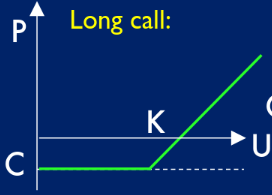
Q: What does a short call payoff look like?
A: 
Q: What does a long put payoff look like?
A: 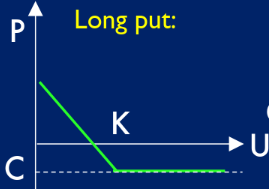
Q: What does a short put payoff look like?
A: 
Q: What does a short butterfly look like?
A:  Means you will make money if the price stays within the range. Long butterfly means you make money if it goes out of the range.
Q: What is a short straddle?
A:  You sell a call and a put, such that if the options expire with the current price at the strike price they are worthless, leaving you with the fee you charged the buyer.
Q: What is a long straddle?
A: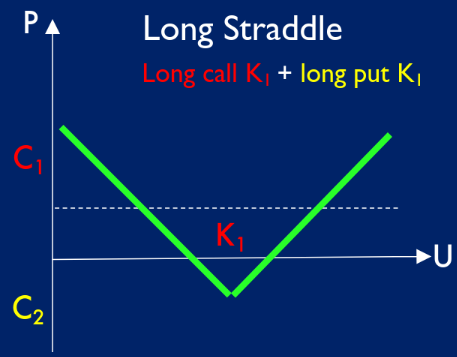 You buy a call and a put, such that when the options expire the price has significantly moved from the strike price.
Q: What is the difference between a straddle and a strangle? A: A strangle has two different strike prices, and tends to be cheaper to purchase.
Q: What is the difference between being long and short? A: In a long, you paid someone else to receive an option. In a short, someone else paid you for an option.
Q: What is the difference between a call and a put? A: A call is an agreement to buy from the issuer. A put is an agreement to sell to the issuer.